
Why Brokers and PEOs Keep Talking Past Each Other, and What a Shared Workspace Fixes
Brokers and PEOs both want the deal closed. The friction is data handoff, status opacity, and re-keying. One shared deal record with two views fixes it.
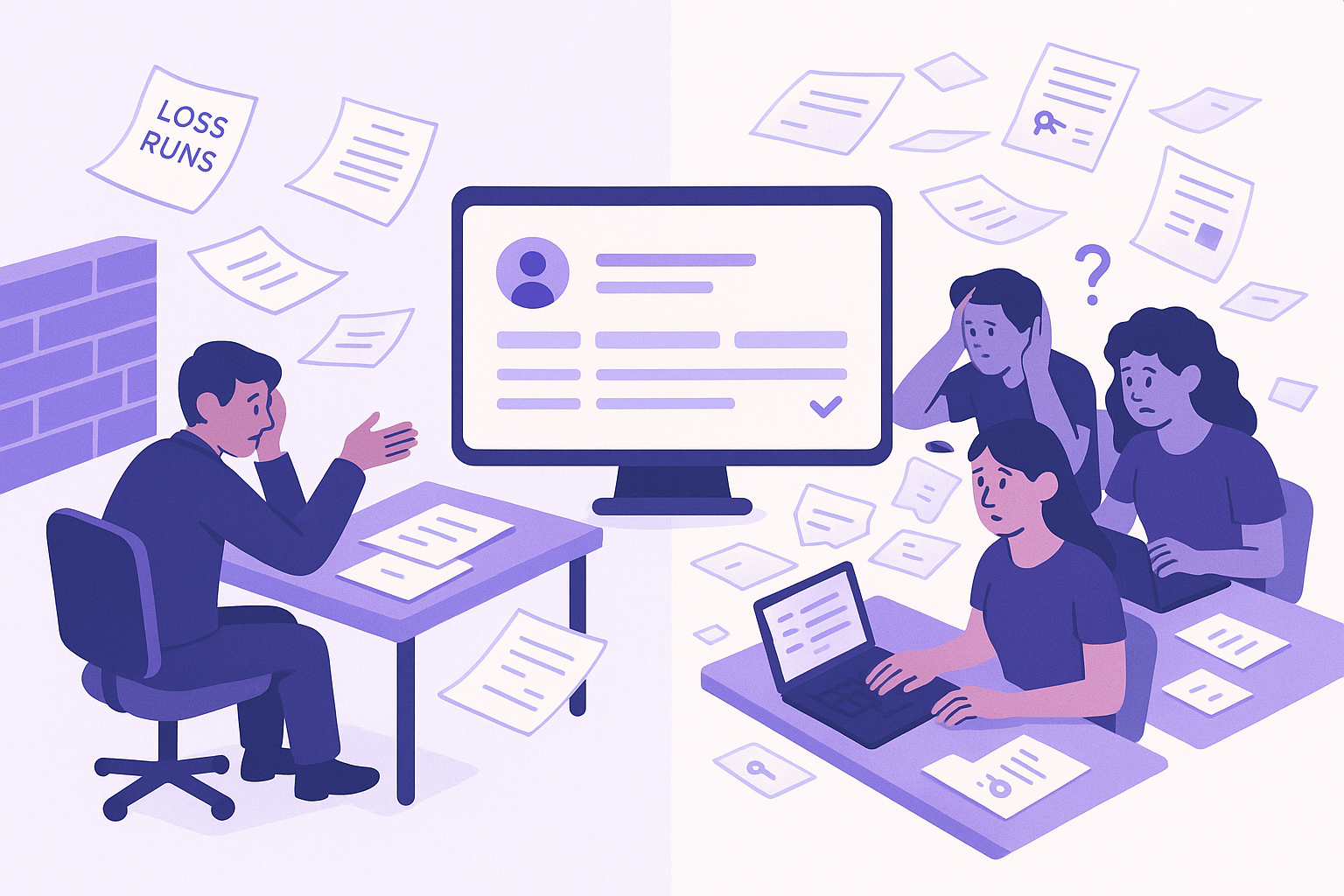
In two decades of selling PEO, the most common complaint I heard from brokers was not about price. It was about silence. They sent a submission, and then nothing. A week later they would call to ask whether anyone had looked at it, and the answer was usually "yes, we're waiting on the carrier," which was true and also useless.
The most common complaint I heard from PEO sales teams was the mirror image. The broker sent half a submission. The loss runs were two years old. The census had no class codes. Three emails later the package was complete, and by then the broker was annoyed and the prospect was cold.
Neither side was wrong. They were working the same deal from two systems that did not know about each other.
Neither one is the other's customer
It helps to be precise about the relationship, because a lot of software gets it wrong. A PEO does not sell to brokers. A broker does not sell to PEOs. Both of them sell to the employer, and they need each other to do it. The broker brings the relationship, the submission, and often the trust. The PEO brings the program, the underwriting, and the service model.
When vendors build tools for this relationship, they tend to pick a side. A PEO's broker portal treats the broker as a lead source to be managed. A broker's agency management system treats the PEO as a market to be quoted. Each tool models the other party as an external contact, and the deal itself, the thing both parties actually care about, exists in two incompatible copies.
That is the root of the friction. Not bad intent, not laziness, just two copies of one deal that drift apart the moment they are created.
Where the friction actually lives
Strip away the frustration and the problems fall into three buckets.
The first is data handoff. The broker has the loss runs, the ACORD, the census, the current dec page. The PEO needs all of it in a form it can underwrite. The broker emails PDFs; the PEO re-keys them. If the PEO asks for something that was missing, the broker has to go back to the employer, who is wondering why this is taking so long. Every round trip is a day.
The second is status opacity. Once the submission is in the PEO's hands, the broker is blind. Has it been parsed? Is it with underwriting? Did the carrier come back? Is there a problem with the mod? The broker's only tool is the follow-up email, which interrupts the people doing the work and rarely gets a precise answer. From the PEO's side, the broker's silence after a proposal goes out is equally opaque. Did the employer see it? Is there a competing quote? Is the deal dead?
The third is re-keying in both directions. The PEO keys the broker's documents into its underwriting model. Then it keys the proposal results into an email back to the broker. The broker keys the proposal into a comparison for the employer. Then the broker keys the employer's questions back into an email to the PEO. Each step loses detail and adds delay, and every number gets typed at least three times by people who did not produce it.
None of these are fixed by better communication habits. They are structural, and the structure is the two-copy problem.
What a shared workspace means
The fix is one record of the deal that both parties can see, with each party seeing the view that fits their role.
The broker's view shows the submission they sent, what the PEO has received and parsed, where the deal stands, what is missing, and the proposal when it is ready. The broker does not see the PEO's internal pricing, the loss fund calculation, or the underwriter's notes. Those are the PEO's business.
The PEO's view shows the same deal with everything underneath it: the parsed loss runs, the mod projection, the carrier rates, the pricing, the proposal draft, and the broker's activity. The PEO does not see the broker's commission arrangements with other markets or the broker's notes on the employer. Those are the broker's business.
Both views update from the same underlying data. When the PEO's underwriter marks the mod analysis complete, the broker sees the status change. When the broker uploads the missing census, the PEO sees it attached to the deal without an email. When the proposal is published, the broker gets the link and can see whether the employer opened it.
This is not a portal in the old sense. The broker is not re-keying anything into the PEO's form. The broker's submission email is the input; the shared deal is what it becomes.
Most of the engineering difficulty in a shared workspace is in getting the boundaries right. The broker and the PEO are different tenants with different roles and different entitlements. The deal is a shared object that each tenant sees through its own lens, and the system has to enforce that at the data layer rather than in the user interface.
We built HALO IQ as a multi-tenant platform where every record is isolated by tenant and every tenant has roles appropriate to its type: PEO, MGA, or broker. A shared deal is a deliberate exception, a record that two tenants are both authorized to see, with each tenant's permissions determining which fields are visible. The underwriter's notes are a PEO-only field. The broker's upload is visible to both. The pricing breakdown is PEO-only until the PEO decides to publish a proposal, at which point the proposal, and only the proposal, becomes visible to the broker.
Getting this wrong in either direction is fatal. Show a broker the PEO's margin and the PEO will never use the platform again. Hide the status from the broker and you are back to the follow-up email.
What changes when both sides can see the deal
The most immediate change is that follow-up emails mostly stop. Not because anyone banned them but because the question they were asking is answered on the screen.
The second change is that submissions get complete faster. When the broker can see that the PEO's intake flagged the census as missing class codes, the broker fixes it that afternoon instead of learning about it a week later in a phone call. The PEO's underwriter never has to compose the "we need a few more things" email, which is the email most likely to sit in a draft folder.
The third change is that proposals get read. A proposal delivered as a link into a shared workspace carries its own status. Both parties can see that it has been opened, and when. That is actionable in a way that "I sent it Tuesday" never was.
The fourth change is subtler. When both parties see the same deal, they stop blaming each other for delays, because the delay is visible and attributable. The broker can see the deal has been with the carrier for four days. The PEO can see the proposal has not been opened. The conversation shifts from "what's going on" to "what should we do about it."
What it does not fix
A shared workspace does not make a bad submission good. If the employer will not produce loss runs, no software gets them. It does not make a PEO's pricing competitive or a broker's relationship with the employer stronger. It does not replace the phone call where the broker and the PEO rep decide together how to position the proposal against an incumbent.
What it does is remove the overhead that was eating the time those conversations should have had. In our own PEO, the hours a sales coordinator spent chasing documents and answering status questions were hours not spent on the next deal. That overhead was never the job; it was the tax on doing the job in two systems.
How we approached it in HALO IQ
ConnectIQ is the CRM inside HALO IQ, and it is organized around the client workspace rather than the contact record for exactly this reason. A deal in ConnectIQ is created from the broker's submission when it arrives through InboxIQ, carries the parsed documents and the analysis that follows, and becomes the shared object both parties work from. Brokers and PEOs are both tenants on the platform, each with their own role, each seeing their own view of the same deal.
We think of it less as a feature and more as a correction. The deal was always one thing. The software should have treated it that way from the start.
HALO IQ
Underwrite and deliver the proposal in one file.
Submissions, mods, and proposals for PEO operators and brokers, without the spreadsheet handoff.
Was this article helpful?