
ModIQ: From Loss Runs to a Defensible Mod Projection in Minutes
How ModIQ turns parsed loss runs into a policy-year aggregation, a mod projection, a WCIRB worksheet request, and a loss pick that holds up under scrutiny.
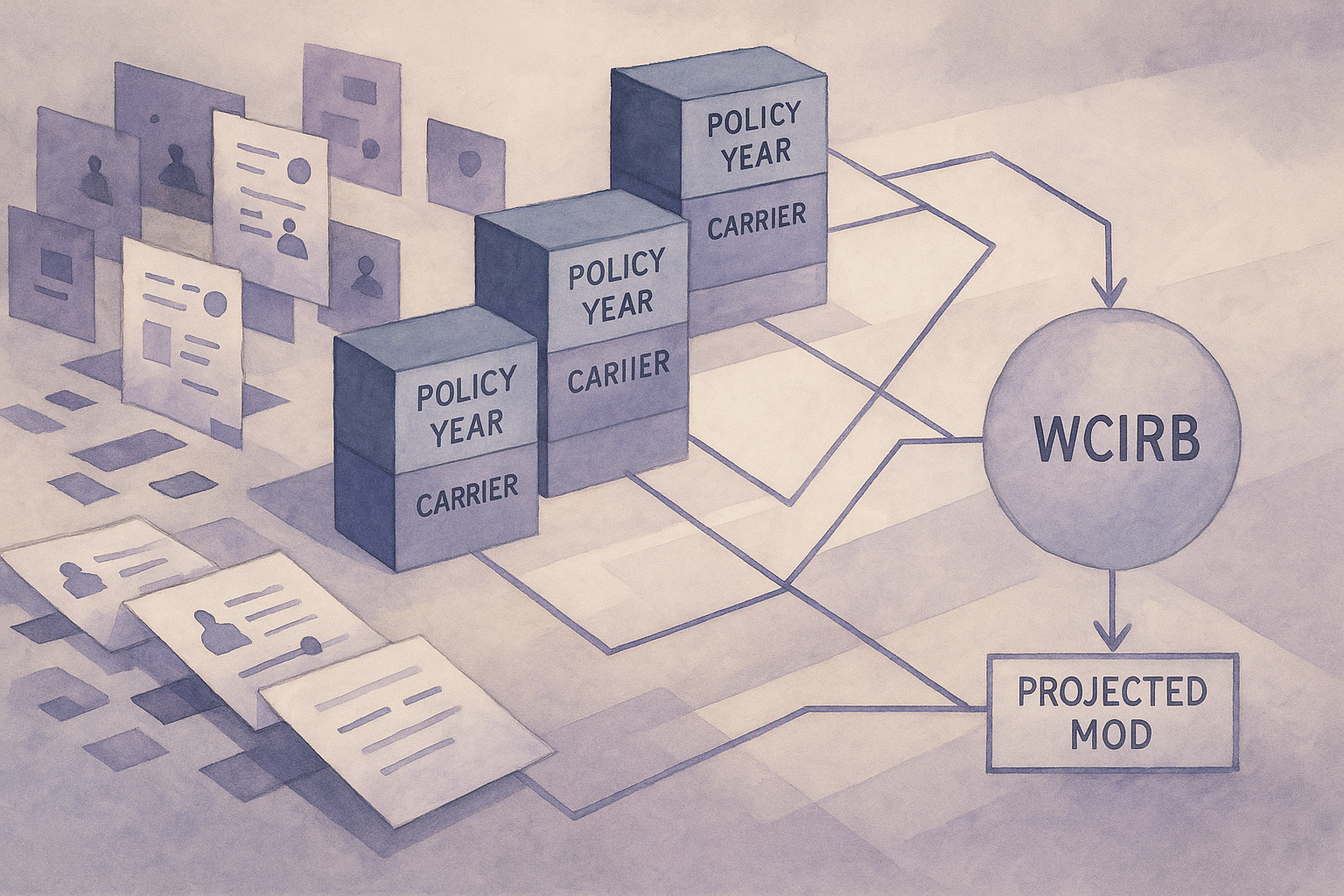
The word we kept coming back to when we designed ModIQ was "defensible." Not fast, although it is fast. Not accurate, although accuracy is the point. Defensible, because every mod projection and every loss pick a PEO produces will eventually be challenged by someone with an incentive to challenge it.
A carrier underwriter will question the pick when the PEO asks for a rate. A broker will question the projected mod when it is higher than the prospect expected. A CFO will question the loss fund when the year closes short. In each case the only acceptable answer is to show the work: here are the inputs, here is the method, here is why we loaded it the way we did. A number without that trail is an opinion, and opinions lose arguments.
ModIQ is the module in HALO IQ that produces those numbers with the trail attached. Here is how it works, from the moment loss runs arrive to the moment a loss pick goes into a proposal.
Step one: the runs arrive already structured
ModIQ does not start with a PDF. It starts with the structured claim data that InboxIQ produced when the submission came in: every claim with its carrier, policy period, valuation date, injury date, status, paid, reserved, and incurred. Known carrier formats were parsed deterministically; unfamiliar formats went through AI extraction and were flagged as such.
This matters because the hardest part of mod work has never been the math. It has been getting the data into a shape where the math can be applied. By the time an underwriter opens ModIQ, that shape exists.
Step two: aggregate by policy year, not by file
The first thing ModIQ does with the claims is assign each one to a policy year using its injury date and the policy effective dates, across every carrier and every run in the submission. Multi-carrier, multi-year loss runs are aggregated by policy year because that is the only unit the rating formulas and the loss pick methods can use.
The principle behind the aggregation is that a policy year with no run covering it is a gap, not a year with zero losses, and that two runs covering the same year at different valuation dates have to be reconciled rather than added. The result is a single policy-year table: carrier, valuation age, claim count, paid, reserved, incurred, with medical-only and indemnity claims distinguished.
This table is the foundation for everything that follows, and it is the thing most spreadsheet workflows get subtly wrong. We wrote about the specific failure modes last week; ModIQ exists partly so that nobody has to do that reconciliation by hand again.
Step three: project the mod
With policy-year losses in hand, ModIQ projects the experience modification. For a California account, that means applying the WCIRB formula: actual primary losses plus expected excess losses, divided by expected losses, using the primary threshold appropriate to the employer's size and the $250 per-claim adjustment the plan applies. California is WCIRB-rated rather than NCCI-rated, and the module treats it as its own system.
The inputs are the payroll by class code from the census and ACORD, the expected loss rates and D-ratios for those classes, and the claims from the aggregated table assigned to the correct experience period. The output is a projected mod for the next rating effective date, with every intermediate value visible: expected losses by class and year, expected primary losses, actual primary losses by claim, the threshold applied.
A projection is not the bureau's published mod, and ModIQ is careful to say so. Its value is in two situations. The first is when the prospect's current mod is about to change and the proposal should reflect where it is heading rather than where it has been. The second is when a PEO on a large-deductible master policy needs to understand the client's loss frequency even though the carrier will not apply the client's mod to the master. In both cases the projection is a diagnostic as much as a number.
The bureau's own worksheet is the authoritative statement of the mod, and when it is missing from the submission, ModIQ prepares the WCIRB worksheet request. When the worksheet arrives, it is parsed through the same intake pipeline, and the underwriter can lay it against the projection.
That comparison is where surprises surface. A claim on the loss run that is not on the worksheet, or a payroll figure on the worksheet that does not match the census, is a discrepancy worth resolving before the proposal goes out. Sometimes it means the carrier underreported, sometimes it means the prospect has grown, and occasionally it means the loss runs the broker sent are not the complete picture.
Step four: the loss pick
The mod tells you about the past. The loss pick is a statement about the future: how much loss the PEO expects to absorb from this client over the coming policy year. It is the number that funds the loss fund and drives the workers' comp component of pricing, and it is the number a carrier will scrutinize hardest.
ModIQ builds the pick using the standard actuarial methods, and it runs more than one. The loss development method applies development factors to each policy year's incurred losses to estimate their ultimate value, then relates ultimate losses to payroll to get a loss rate. Bornhuetter-Ferguson blends the developed actual losses with an expected loss figure, giving more weight to expectation for immature years where actual losses are mostly unreported. Cape Cod is a related approach that derives the expected loss rate from the account's own data across years rather than from an outside assumption.
The methods disagree, and that is the point. A single method applied to a single year is fragile. ModIQ shows each method's result by policy year and then blends them, with credibility weighting that gives more weight to the account's own experience when there is more of it and leans on expected losses when there is less.
The blended pick is then loaded, and this is where PEO underwriting diverges from standard actuarial practice. A PEO's book carries risks that a carrier's does not. A single large client can dominate a small loss fund, so the pick carries a load for client concentration. Clients that are growing will have more payroll, and therefore more unreported claims, than their history suggests, so the pick carries a load for payroll-growth IBNR. Open reserves on the loss run are the carrier's opinion and may be light, so the pick carries a margin above them. Each load is a separate line with its own rationale, not a fudge factor buried in a multiplier.
Why "defensible" is the design requirement
Here is the conversation we built ModIQ to win.
A carrier underwriter looks at the PEO's requested rate for a new client and says the loss pick is too low. The PEO's underwriter opens ModIQ and walks through it. Here are the loss runs, parsed from the carrier's own format. Here is the policy-year aggregation with the coverage timeline showing no gaps. Here is the development method result, the Bornhuetter-Ferguson result, and the Cape Cod result by year, and here is the credibility weight applied to each. Here is the concentration load, the growth load, and the reserve margin, each stated separately. If you think the development factors are wrong, let us talk about which ones you would use.
That conversation ends with a negotiation about assumptions, which is the right conversation. The alternative, a number in a spreadsheet cell with a formula nobody remembers, ends with the carrier's number winning by default.
The same trail serves the broker and the prospect. When a projected mod lands higher than the prospect expected, the answer is not "the model says so." It is the list of eleven claims under the primary threshold that drove it, which is a conversation about safety and return-to-work rather than an argument about software.
Where AI fits, and where it does not
ModIQ's math is deterministic. Development factors, Bornhuetter-Ferguson, credibility blending: these are formulas, and formulas should run the same way every time. We did not put a language model in the middle of a mod calculation, and we would be suspicious of anyone who did.
AI is in the pipeline in two places. It parses the loss runs that no deterministic template matches, so the data reaches ModIQ at all. And it drafts the narrative that explains the pick in a proposal, from the structured results, so the underwriter is editing an explanation rather than writing one from scratch. Both are jobs where a model earns its keep. Neither is a job where a model should be trusted to decide.
Taken together, the steps above are what let a PEO go from a broker's email to a defensible mod projection and loss pick in the time it used to take to key the first loss run. The submission lands, InboxIQ parses it, ModIQ aggregates, projects, and picks, and the underwriter spends their time where it belongs: on the judgment calls about loads and assumptions, with the evidence for each one on the screen.
That is what we mean by defensible. Not that the number cannot be challenged, but that when it is, the answer is already written.
HALO IQ
Underwrite and deliver the proposal in one file.
Submissions, mods, and proposals for PEO operators and brokers, without the spreadsheet handoff.
Was this article helpful?