
Class code drift: how staffing firms lose premium at audit
In staffing, classification follows the work actually performed at the client site, not the job title on the placement order. How drift happens, what the premium audit finds, and the controls that prevent six-figure audit bills.
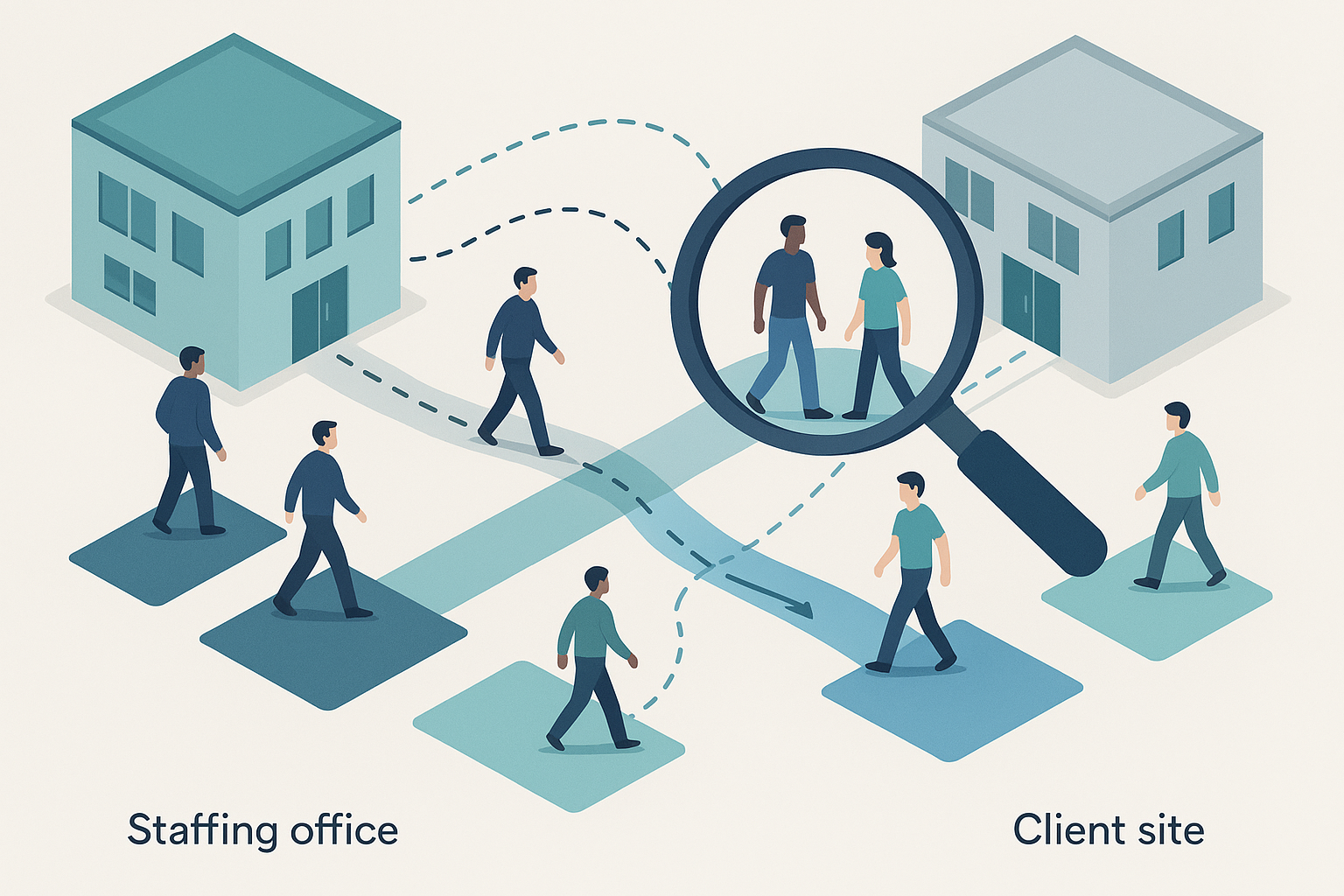
Every workers' comp policy a staffing firm buys is priced on an estimate: this much clerical payroll, this much light industrial, this much skilled trades. Twelve months later the premium auditor prices what actually happened. The gap between those two numbers has a name — class code drift — and in staffing it is structural, not occasional, because the thing being classified isn't under the employer's roof.
Why staffing drifts by design
In workers' compensation, classification follows the work actually performed, not the job title, not the placement order, and not what the client said the role would be. For a conventional employer that's a stable fact. For a staffing firm it moves constantly, for three structural reasons:
- The work happens at client sites, under client supervision. The client who ordered "warehouse associates — picking and packing" starts having them operate forklifts in week three. Nobody calls the staffing firm's risk department. The classification changed; the payroll records didn't.
- The mix shifts continuously. New clients, seasonal surges, and churn mean the ratio of clerical to light-industrial to trades payroll is different every month. The policy was bound on last year's mix.
- Assignments outlive their descriptions. A placement opened as one role gets extended, modified, and redeployed. The code attached at intake follows the worker like a label nobody re-reads.
What the audit does with it
The premium audit reclassifies payroll to match the work performed and re-prices the year at the correct rates — retroactively. The arithmetic is unforgiving. Take an illustrative example (representative rates, not any carrier's filing):
- 400,000 of payroll placed as clerical at ~$0.25 per $100 ≈ $1,000 of premium
- The same 400,000 found at audit to be warehouse work at ~$5.00 per $100 ≈ $20,000
One drifted account, one year: a $19,000 audit bill, due at once, on revenue the staffing firm already booked at a bill rate that assumed the cheap code. Multiply across a book and audit season becomes the worst quarter of the year. And the damage compounds: the corrected payroll feeds the experience rating data, the injuries that happened in the misclassified work were already telling the carrier's claims department a different story than the payroll did, and an underwriter who sees audit-driven reclassification two years running prices the next policy assuming the estimates are wrong.
There's a second-order cost specific to staffing: bill rates. If the client was billed on a clerical-grade workers' comp load, the margin on that account was overstated all year. The audit doesn't just bill you; it tells you an account you thought was profitable wasn't.
The controls that actually work
Drift can't be eliminated — the work really does change — but it can be caught in weeks instead of at audit:
Classify the assignment, not the requisition. Intake should record the duties, the equipment, and the environment at the client site, and the code should be assigned from those facts. "Title vs. duties" mismatches are the single most common finding when we review staffing books.
Re-verify on every assignment change. Extension, redeployment, added duties — each one is a classification event. Make the re-check part of the workflow that processes the change, because a separate periodic review will always lag.
Monitor the mix monthly against the bound estimate. The blended rate across your whole book — total premium over total payroll — is the one number that moves whenever drift happens, even when no single placement looks wrong. Track it against what the policy was bound on, and investigate when it moves.
Walk the sites that matter. For any client site carrying concentrated payroll, someone from the staffing firm should periodically see the work. Client supervisors change the job without telling anyone; the floor doesn't lie.
Reprice bills when codes change. If an assignment reclassifies upward, the bill rate conversation with the client happens now, not after the audit lands.
Keep the evidence. When the auditor proposes a reclassification, the firm that documented duties at intake and at each change can contest it with records. The firm that has job titles loses by default.
The underwriting angle
A staffing firm that can show an underwriter per-assignment classification records, a monthly mix report against the bound estimate, and a clean audit history is submitting proof that the estimate is real. In a market where carriers are scrutinizing staffing classifications closely, that documentation is worth real schedule credit — and it's the difference between an audit that confirms the premium and one that rewrites it.
HALO IQ's staffing module tracks exposure by state, class, and client site against the bound estimate and flags blended-rate drift as it happens — not at audit. See it on your book.
HALO IQ
Underwrite and deliver the proposal in one file.
Submissions, mods, and proposals for PEO operators and brokers, without the spreadsheet handoff.
Was this article helpful?